From Paganism to Christianity
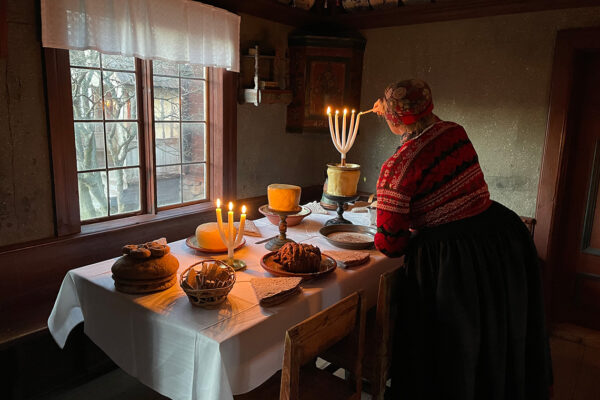
As Sweden gradually transitioned from paganism to Christianity, the Christian calendar in many ways complemented the existing agricultural year. For centuries, the working year had already been shaped by the changing seasons and marked by social gatherings and seasonal festivities.
Celebrating the birth of Jesus according to Christian tradition fitted naturally with the festive customs that already existed around the time of the winter solstice. There was already a name for this time of year – jul – and the word continued to be used, taking on a broader meaning with the introduction of Christian traditions.
Many rituals and symbolic practices from pagan times also survived. The tradition of dricka jul (literally, “drinking Christmas”), in which people raised their drinking horns to wish one another good fortune, continued even after the arrival of Christianity, although now in honour of God and Christ. Generosity also became an important part of Christmas celebrations, with people expected to help their fellow human beings, regardless of their social standing.
The celebration of Christmas therefore has its roots in an ancient seasonal festival that has long been marked by ceremonial traditions. With the arrival of Christianity, these traditions were reinterpreted and expanded.
The Evolution Of Father Christmas
In Swedish folklore, the gårdstomte was a guardian of the farm and its animals. He could help the people who treated him well, but could also become dangerous if the animals were neglected or he was displeased. Leaving him a bowl of porridge was one way of keeping him happy.
However, this grey-clad figure did not deliver Christmas presents. The Father Christmas we know today has evolved from several different traditions, combining the Swedish gårdstomte with European gift-giving customs associated with Saint Nicholas, the patron saint of children.
In the late 19th century, illustrations by artists such as Jenny Nyström helped shape the appearance of the Swedish Father Christmas.
Gifts from the Christmas Goat
The tradition of giving Christmas presents dates back to earlier times, when people would not turn away those who came begging from farm to farm during the Christmas season. In the 18th century, the exchange of gifts became a custom among the upper classes, and by the early 19th century, it had become increasingly common to give presents wrapped in paper and accompanied by rhyming verses. Traditionally, wrapping was simple, using plain paper sealed with wax. Towards the end of the 19th century, however, ribbons and decorative wrapping paper became increasingly popular.
Before Father Christmas took over the role, Christmas presents could be delivered by someone dressed as a goat. During the 18th and 19th centuries, the Christmas goat sometimes appeared as a gift-bringer in upper-class households. But he could also be a noisy and rather frightening character, known for his mischievous antics.
The goat also appeared in religious plays in continental Europe, alongside Saint Nicholas. In these performances, the saint sometimes led a goat on a leash, symbolising the Devil brought under control.
The Christmas goat has therefore played several different roles throughout history. Today, we most often encounter him as a traditional figure made of straw.
New Traditions in the 20th Century
Christmas continued to evolve throughout the 20th century. The Advent calendar originated in Germany, whilst mistletoe and turkey, for example, are associated with Anglo-Saxon Christmas traditions.
New forms of entertainment also became part of the festivities. Since 1960, Donald Duck have been a familiar part of Christmas Eve in Sweden, with a special programme broadcast on Swedish television every year. For many families, watching it together has become an essential Christmas tradition.
What we think of today as a traditional Swedish Christmas is therefore made up of customs and influences from different times and places.