Lucia In The Christian Tradition
The Swedish Lucia tradition takes its name from Lucia of Syracuse in Sicily. Her name is linked to the Latin word lux, meaning light. According to legend, Lucia lived around the year 300 and was martyred for her Christian faith and for giving food to the poor.
In the Middle Ages, when Sweden was a Catholic country, 13 December was dedicated to Lucia in the church calendar. After the Reformation in the 16th century, the veneration of saints came to an end, but Lucia’s name remained in the calendar.
Today’s Swedish Lucia celebrations are not a direct continuation of the traditions associated with the saint. Instead, they have also been shaped by folk customs linked to this time of year.
Lussenatten In Rural Sweden
Lussenatten is the night of 12–13 December, traditionally associated with folklore and supernatural beliefs in Sweden. In the past, it was thought to be the longest night of the year, and this belief persisted even after Sweden adopted the Gregorian calendar in 1753.
In rural communities, darkness and light held great symbolic significance. According to folklore, Lussenatten was a dangerous night when supernatural forces were believed to roam. In some places, the name Lucia was also associated with Lucifer, the devil. Staying awake and keeping watch until dawn was one way to get through the long night.
Celebrations, Food And Costumes
Lucia also marked the end of the farming season and, in many parts of western Sweden, was a day of celebration known as Lusse långnatt, sometimes called Little Christmas Eve. It was not unusual for those who could to eat three, seven or even eleven breakfasts. During the Catholic era, the Christmas fast also began on Lucia, which provided an excuse to eat heartily beforehand.
One of the festival’s playful figures was the Lusse bride. She might be dressed in straw or even consist of a straw doll with which people danced. The local young people would also dress up as Lusse men and Lusse brides and go from farm to farm singing and asking for food and drink. What they collected might be used for a communal feast or shared with someone in need. These boisterous celebrations were very different from today’s traditional Lucia processions.
The White-Clad Lucia
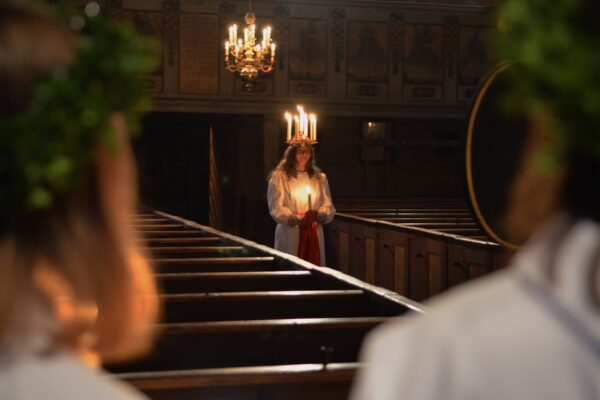
Alongside the festivities of rural communities, another custom emerged amongst the upper classes of western Sweden. The earliest known record of a white-clad Lucia making her morning rounds dates from 1764 at Horns in Västergötland. She wore angel’s wings and carried candlesticks in her hands.
During the 18th and 19th centuries, morning visits took place in which Lucia would wake the household with coffee and something to eat. She would come alone or with a couple of companions.
The custom spread further, including to the university towns. At the western Swedish student nations in Uppsala and Lund, Lucia was a man; often the most handsome first-year student was chosen – at that time, there were no female students at the universities.
The white robe, the candles and the red sash have also been interpreted as Christian symbols. The red sash around the waist, for example, has been interpreted as a symbol of the blood that the saint sacrificed for her faith. However, this is an interpretation of the costume, rather than an explanation of the origins of the entire Lucia tradition.
A Singing Lucia Procession
Over time, Lucia’s retinue grew and was expanded to include attendants and star boys. The star boys had previously appeared in so-called ‘star boy plays’ as the Three Wise Men in Christmas processions on Boxing Day and Twelfth Night.
The singing tradition has its roots, amongst other things, in upper-class circles and in the choirs of universities and secondary schools in connection with Christmas celebrations. During the 20th century, the Lucia tradition spread to homes, schools, clubs and churches. A major turning point came in 1928, when the Swedish newspaper Stockholms Dagblad organised a Lucia competition in Stockholm. The winning Lucia was crowned and led through the city in a procession, helping to popularise the tradition across Sweden.
The music, too, reflects the tradition’s many influences. The melody of the well-known Lucia song comes from the Italian song ‘Santa Lucia’, whilst the Swedish lyrics we associate with the celebration were written in the 1920s.